

00 / BUYING IN TOKYO
Key takeaways
- Foreigners and non-residents can own Tokyo land and buildings outright, freehold, with no visa, residency or government approval required.
- New in 2026: non-residents must report every acquisition to the Ministry of Finance within 20 days (since 1 April 2026), and every individual buyer declares their nationality when the title is registered (since 5 October 2026). Neither restricts the purchase.
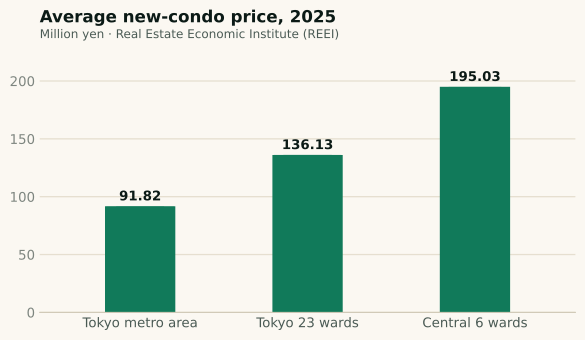
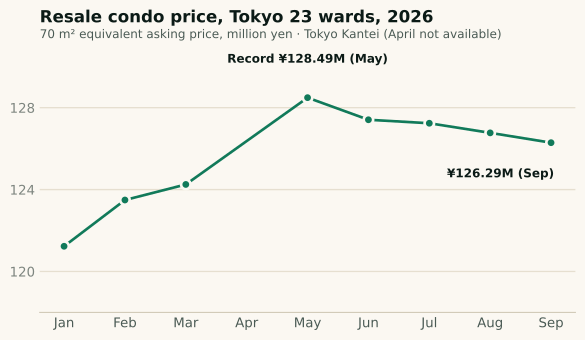
- The average new condo in the 23 wards cost ¥136.13 million in 2025 (+21.8%); ¥195.03 million in the central 6 wards. Resale prices peaked at ¥128.49 million (70 m²) in May 2026 and eased for four months to ¥126.29 million in September.
- Budget about 6–9% on top of the price for closing costs on a brokered resale condo.
- A bill requiring prior government approval for land near certain defence and coast-guard sites, for all buyers regardless of nationality, was approved for submission to the Diet on 23 October 2026. It is not law yet and does not cover ordinary Tokyo condominiums.
Average new condo, Tokyo 23 wards, 2025
REEI, +21.8% y/y
Resale condo, 70 m², 23 wards, Sept 2026
Tokyo Kantei, 4th monthly fall
Foreign residents in Tokyo, 1 Jan 2026
TMG, +8.66% in one year
FEFTA reporting deadline for non-residents
Ministry of Finance, since 1 Apr 2026
01 / BUYING IN TOKYO
The short answer: yes, with two new filings in 2026
Japan places no nationality, visa or residency condition on buying ordinary homes and land. A foreign buyer, whether living in Tokyo or in Paris, receives the same freehold title (所有権) as a Japanese buyer, registered at the Legal Affairs Bureau (法務局), and can sell, rent out, mortgage or bequeath the property freely. There is no foreign-ownership quota, no leasehold-only regime and no requirement to form a local company. This has not changed.
If you are still deciding whether Tokyo is the right market for you, read our companion analysis, Investing in Tokyo real estate in 2026. This article focuses on how to buy and what it costs.
1 April 2026 — the FEFTA acquisition report now covers homes
Under the Foreign Exchange and Foreign Trade Act (外為法, FEFTA), a non-resident who acquires real estate in Japan, or a right over it such as a mortgage or lease, must file a "Report on the acquisition of real estate or rights related thereto in Japan" with the Minister of Finance, through the Bank of Japan, within 20 days of the acquisition. Until 31 March 2026, buying a home for your own or your family's use was exempt. For acquisitions dated 1 April 2026 or later, the Ministry of Finance's FAQ states that the report is required regardless of purpose and even when the amount is zero, and it explicitly includes acquisitions by inheritance or bequest. A resident agent, typically your broker, can file on your behalf, on paper or online.
What matters is residency, not nationality. A French national who works in Tokyo is a "resident" for FEFTA purposes and does not file. A Japanese citizen who lives in Singapore is a "non-resident" and does file. The FAQ's working rule: a foreign national is presumed a non-resident unless they work at an office in Japan or entered Japan more than six months earlier.
5 October 2026 — nationality is now declared at registration
The Ministry of Justice amended the Real Property Registration Rules by Ordinance No. 23 of 2026, promulgated on 31 March 2026 and effective 5 October 2026. Every individual who becomes a registered owner through a sale, gift or inheritance now declares their nationality as a "search information" item and attaches proof: Japanese nationals use a residence certificate showing their family-register domicile or a passport copy; foreign nationals use a passport copy (nationality page), a residence card, a special permanent resident certificate or a residence certificate showing nationality. Expired passports are not accepted. The nationality is kept in an internal file and does not appear on the public register or on the certificate of registered matters that anyone can obtain. Owners registered before 5 October 2026 are not affected retroactively.
Several English-language guides published in spring 2026 say nationality disclosure started on 1 April 2026. The primary source, MOJ Ordinance No. 23, sets 5 October 2026. The April date belongs to the FEFTA change above. If a page you are reading mixes the two, it is out of date.
What is proposed, and what is not law
Two threads of debate ran through 2026. First, a plan to curb condominium purchases by foreigners was dropped: on 5 June 2026 Nikkei Asia reported that the government and the LDP decided not to include restrictions on real-estate purchases by foreign nationals in the summer policy platform, choosing instead to collect data on foreign ownership. Second, on 2 October 2026 an expert panel recommended a permit system for land within roughly 1,000 metres of Self-Defense Forces and Japan Coast Guard facilities considered vulnerable to drone attack, and on uninhabited border islands. A draft bill presented on 14 October would require prior approval from the central government for those transactions, with penalties of up to three years' imprisonment or a ¥3 million fine, and would apply to Japanese and foreign buyers alike. Jiji Press reported on 23 October 2026 that the Cabinet approved the bill for submission to the Diet. As of November 2026 it is not law, and central Tokyo residential condominiums are outside the zones described. We will update this page as the bill moves.
02 / BUYING IN TOKYO
How much does Tokyo property cost in 2026?
New condominiums
The Real Estate Economic Institute (不動産経済研究所, REEI) is the benchmark source for new launches. For calendar 2025 it reported an average of ¥136.13 million in the 23 wards (+21.8%), the third straight year above ¥100 million; ¥195.03 million in the central 6 wards (Chiyoda, Chuo, Minato, Shinjuku, Bunkyo, Shibuya; +20.2%); and ¥91.82 million across the Tokyo metropolitan area (+17.4%). Supply fell to 21,962 units in the metro area, the fewest since the survey began in 1973, with 8,064 units in the 23 wards. Scarce land and construction costs are the drivers, not a demand collapse. For fiscal 2025 (April 2025 to March 2026) the 23-ward average was ¥137.84 million (+18.5%).
Resale condominiums: the 2026 turning point
Tokyo Kantei (東京カンテイ) publishes a monthly asking price converted to a 70 m² unit. The 23-ward figure rose for 25 consecutive months to a record ¥128.49 million in May 2026, up 27.4% year on year. It then slipped for four months in a row to ¥126.29 million in September 2026 (−0.4% month on month), while the central 6 wards fell for a fifth month to ¥177.86 million (−1.6%). The driver is unsold stock: more listings now carry price cuts. For a buyer, this is the first real negotiating window in two years. It is a cooling of asking prices, not a crash.
Land prices by ward
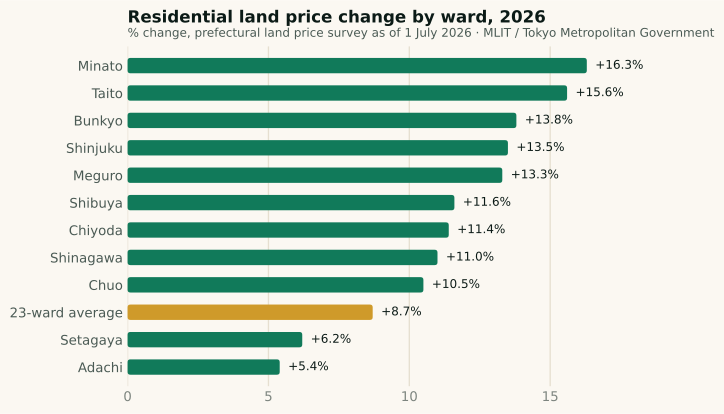
Land underpins every price above. The national land price survey as of 1 January 2026 (地価公示) showed 23-ward residential land up 9.0%, after 7.9% the year before, led by Minato (+16.6%), Taito (+14.2%) and Shinagawa (+13.9%). The Tokyo prefectural survey as of 1 July 2026 (基準地価) showed +8.7% for the 23 wards, led by Minato (+16.3%), Taito (+15.6%) and Bunkyo (+13.8%). The core is still outrunning the periphery: Adachi (+5.4%), Katsushika (+5.8%) and Nerima (+5.9%) rose at roughly a third of the pace of Minato.
03 / BUYING IN TOKYO
Who is buying? Foreign demand in numbers
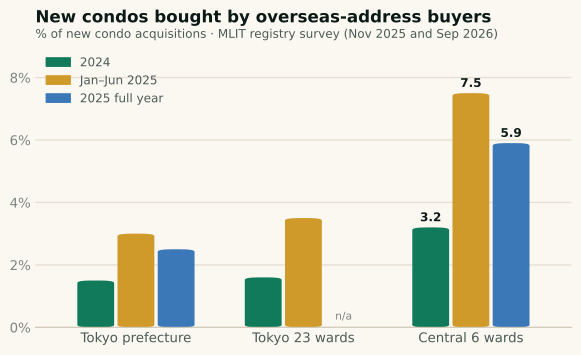
In November 2025, MLIT published the government's first registry-based study of new condominium buyers. For January to June 2025, buyers with an overseas address acquired 3.0% of new condos in Tokyo prefecture (1.5% in 2024), 3.5% in the 23 wards (1.6%) and 7.5% in the central 6 wards (3.2%). Shinjuku-ku was highest at 14.6%. Of the 308 units bought by overseas residents in the 23 wards, 192 were bought from Taiwan, 30 from China and 21 from Singapore. MLIT's conclusion was that overseas buyers are not the main driver of price inflation.
The follow-up released on 15 September 2026 covered full-year 2025: 2.5% in Tokyo prefecture (down 0.5 points from the first half), 5.9% in the central 6 wards, 3.4% in Osaka, 2.2% in Kyoto and 0.5% in Aichi. The same release introduced a broader, name-based estimate of buyers "presumed foreign", which includes foreign residents of Japan; secondary reports put that figure at 11.9% for condo purchases in the central 6 wards. The two definitions are not comparable: "overseas address" counts Japanese expatriates and excludes foreigners living in Tokyo.
Behind this demand is a fast-growing expatriate base. Tokyo had 783,701 foreign residents on 1 January 2026, up 62,478 (+8.66%) in a year, about 5.6% of the population (Tokyo Metropolitan Government, resident register). Nationally, foreign residents reached a record 4.03 million. A separate Immigration Services count gives 801,438 for Tokyo at end-2025; the two series use different bases.
04 / BUYING IN TOKYO
Full cost breakdown: buying a ¥100 million resale condo
| Cost item | Legal basis / rate | Indicative amount |
|---|---|---|
| Brokerage fee | Cap: 3% + ¥60,000 + 10% consumption tax on prices above ¥4 million (shortcut for the tiered bands of MLIT Notice No. 1552, as amended by Notice No. 949 of 2024) | ¥3,366,000 max |
| Registration and licence tax, land (transfer) | 1.5% of assessed value until 31 March 2029 (standard 2%) — NTA Tax Answer No. 7191 | Depends on assessed value |
| Registration and licence tax, building (transfer) | 2%; 0.3% for qualifying owner-occupied homes of 50 m² or more until 31 March 2027 | Depends on assessed value |
| Real estate acquisition tax | 3% for land and residential buildings until 31 March 2027 (standard 4%), on assessed value, with reliefs for owner-occupied homes | Often reduced substantially |
| Judicial scrivener (司法書士) | Market rate | ¥100,000–¥300,000 |
| Stamp duty on the contract | Stamp Tax Act, reduced rates for real-estate contracts | ¥30,000 (¥50M–¥100M band) |
| Pro-rated fixed-asset tax, management fees | Settled at closing | Varies |
| Mortgage costs (if any) | Guarantee fee, bank fees, 0.1% mortgage registration for qualifying homes | Varies |
| Fire and earthquake insurance | Optional but usual | Varies |
| Rule of thumb | 6–9% of price |
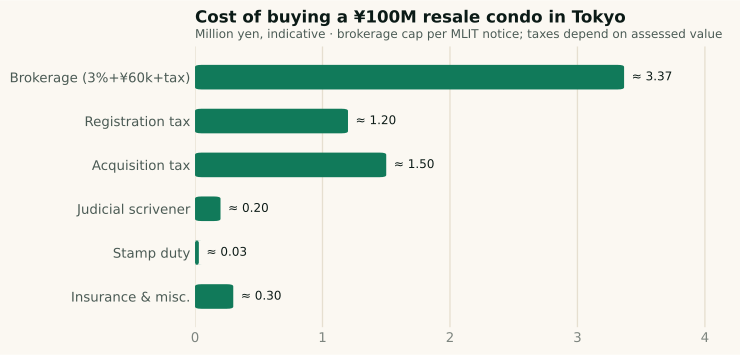
The Ministry of Justice's registration-tax handout still shows the 1.5% land rate expiring on 31 March 2026. The National Tax Agency page, stated as law in force on 1 April 2026, shows the extension to 31 March 2029 under the FY2026 tax reform. We use the NTA date.
05 / BUYING IN TOKYO
Step by step: how a foreigner buys in Tokyo
- Define the budget and the currency plan. Your purchasing power moves with USD/JPY or EUR/JPY; model it before you view.
- Engage a licensed broker. Only a licensed real-estate transaction business (宅地建物取引業者) may broker a sale in Japan. GAISAPP works with licensed partner Livmo (Tokyo Governor (3) No. 98974).
- View and make an offer. You sign a purchase application (買付証明書), which is not binding.
- Important Matters Explanation (重要事項説明). A licensed transaction specialist must explain the property's legal and physical condition before you sign.
- Sale contract and deposit. Typically 5–10% of the price.
- Settlement and registration. You pay the balance; the judicial scrivener registers the transfer the same day. Since 5 October 2026 the application includes your nationality declaration.
- Within 20 days (non-residents only). File the FEFTA acquisition report through the Bank of Japan, or have your resident agent do it.
- After closing. Register a domestic contact if you live abroad, appoint a tax agent (納税管理人) for fixed-asset tax, and set up payment of management and repair-fund fees.
06 / BUYING IN TOKYO
Mortgages, visas and residency status
Owning property gives no right to live in Japan; a visa is a separate matter. Japanese banks generally lend to foreign residents with permanent residency, or with a stable work history in Japan and yen income. Non-residents are rarely financed by domestic banks and usually buy in cash or through specialist lenders in their home country. If you live abroad, plan for a cash purchase, and factor in wire-transfer timing and the FEFTA report.
07 / BUYING IN TOKYO
Ongoing obligations after you buy
- Fixed-asset tax and city-planning tax are billed every year by the ward; a tax agent handles this for non-residents.
- Address and name changes must be updated on the register within two years, since 1 April 2026, with a fine of up to ¥50,000; changes that occurred before April 2026 must be registered by 31 March 2028.
- Selling later as a non-resident: the buyer generally withholds 10.21% of the price and pays it to the tax office. Our companion guide, Selling inherited property in Japan from overseas, explains the mechanics and the capital gains rates.
08 / BUYING IN TOKYO
Frequently asked questions
Can foreigners buy property in Japan in 2026?
Yes. There is no nationality, visa or residency requirement for ordinary homes and land. Since 2026, non-residents file a FEFTA report within 20 days of acquiring, and every individual buyer declares nationality when the title is registered.
Do I need a visa to buy an apartment in Tokyo?
No. A visa is needed to live in Japan, not to own property there.
What is the FEFTA acquisition report?
It is the post-acquisition report a non-resident files with the Minister of Finance through the Bank of Japan within 20 days of acquiring Japanese real estate. Since 1 April 2026 it applies to homes as well as investments, including property acquired by inheritance.
Is Japan banning foreign property buyers?
No. A bill approved by the Cabinet on 23 October 2026 would require prior government approval for land within about 1,000 metres of drone-vulnerable SDF and Coast Guard sites and on uninhabited border islands, for all buyers regardless of nationality. It is not yet law and does not cover ordinary Tokyo condominiums.
How much is a condo in central Tokyo?
In 2025 the new-condo average was ¥136.13 million in the 23 wards and ¥195.03 million in the central 6 wards (REEI). The resale 70 m² average was ¥126.29 million in September 2026 (Tokyo Kantei).
What are closing costs in Japan?
Typically 6–9% of the price for a brokered resale condo: brokerage capped at 3% + ¥60,000 + tax, registration tax, acquisition tax, scrivener and loan costs.
Can a non-resident get a mortgage in Japan?
It is rare and difficult. Most non-residents buy in cash.
Will my nationality be public on the land register?
No. It is stored internally by the Legal Affairs Bureau and does not appear on the certificate of registered matters.
Sources and methodology
This article is general information, not legal, tax or investment advice. Rules and figures are correct to the best of our knowledge as of 5 November 2026 and will be updated after each Tokyo Kantei monthly release, the REEI annual release, the March and September land price surveys and any progress of the defence-zone bill. Confirm your own situation with a licensed judicial scrivener and tax accountant.
- [1]Ministry of Finance, FEFTA real-estate acquisition reporting, system overviewmof.go.jp/…/seido_gaiyo.html
- [2]
- [3]Ministry of Finance, English leaflet on reportingmof.go.jp/…/real_property_leaflet.pdf
- [4]Ministry of Finance, ordinance revision of 20 February 2026mof.go.jp/…/gaitamehou_20260220.html
- [5]
- [6]Tokyo Legal Affairs Bureau, notice on the 5 October 2026 changehoumukyoku.moj.go.jp/tokyo/content/001469717.pdf
- [7]Meigi-henkou.jp, practitioner summary of the nationality declaration rulesmeigi-henkou.jp/fudosan-kokuseki
- [8]REEI via nippon.com, 23-ward new condo average ¥136.13M in 2025nippon.com/ja/japan-data/h02685/
- [9]Tokyo Kantei via Kyodo/Kumanichi, 23-ward resale price September 2026kumanichi.com/articles/2049317
- [10]Tokyo Kantei via Kyodo/Kumanichi, record May 2026kumanichi.com/articles/2005817
- [11]Tokyo Kantei via Nomu.com, August 2026 70 m² reportnomu.com/…/70m2_20260924.html
- [12]MLIT via nippon.com, overseas-address buyers 3.5% of 23-ward new condos, Jan–Jun 2025nippon.com/ja/japan-data/h02624/
- [13]MLIT via Kyodo/OANDA, full-year 2025 overseas-address shares (15 Sept 2026)oanda.jp/lab-education/?p=128089
- [14]Tokyo Metropolitan Government, foreign residents 1 January 2026metro.tokyo.lg.jp/…/2026032310
- [15]Tokyo Metropolitan Government, prefectural land price survey 2026 (15 Sept 2026)metro.tokyo.lg.jp/…/2026091022
- [16]
- [17]
- [18]MLIT, Notice No. 949 of 2024 amending brokerage fee capsmlit.go.jp/…/001750937.pdf
- [19]
- [20]Jiji Press via nippon.com, 14 and 23 October 2026, defence-zone land billnippon.com/en/news/
- [21]Japan Law Translation, Real Property Registration Actjapaneselawtranslation.go.jp/en/laws/link/2030