

00 / SELLING FROM ABROAD
Key takeaways
- Registering an inheritance is mandatory since 1 April 2024: within 3 years of learning you inherited, or by 31 March 2027 for inheritances before that date. The fine is up to ¥100,000.
- Everything can be done from abroad by power of attorney, with a judicial scrivener, a tax agent and a licensed broker. You do not need to fly to Japan.
- When a non-resident sells, the buyer generally withholds 10.21% of the price; the final tax is settled in a Japanese tax return and any excess is refunded.
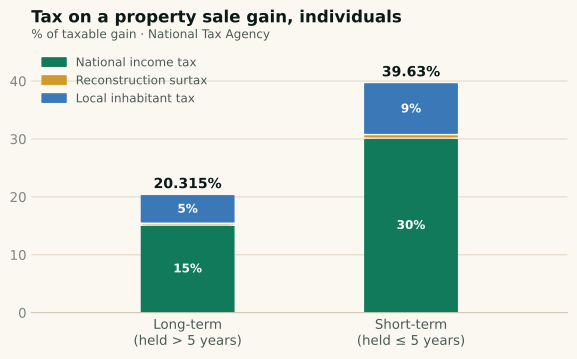
- Gains are taxed at 20.315% if the property was held more than 5 years at 1 January of the sale year (39.63% if 5 years or less); for most non-residents the effective rate is the national portion, 15.315% or 30.63%. The deceased's holding period carries over to the heir.
- Central Tokyo condo prices are just off their May 2026 record, so the window to sell is favourable; Japan has 9.0 million vacant homes, so rural property is a different story.
Deadline to register inheritances that occurred before April 2024
Ministry of Justice
Withheld by the buyer when the seller is a non-resident
NTA Tax Answer No. 2879
Vacant homes in Japan, 13.8% of the stock
Statistics Bureau, 2023 survey
Resale condo, 70 m², Tokyo 23 wards, Sept 2026
Tokyo Kantei
01 / SELLING FROM ABROAD
Can you sell from abroad? Yes, and here is how it works
A judicial scrivener (司法書士) can register the inheritance under a power of attorney. A licensed broker can value, market and sell the property, with the contract and settlement signed by proxy or at a Japanese embassy or consulate. A tax agent (納税管理人) files your Japanese return. The sale proceeds are wired to your overseas account. The sequence takes several months, and the document gathering usually takes longer than the sale itself. If you need the wider market context first, read Can foreigners buy property in Tokyo? The 2026 rules and Investing in Tokyo real estate in 2026.
02 / SELLING FROM ABROAD
First, the deadlines you cannot ignore
Mandatory inheritance registration (相続登記の義務化)
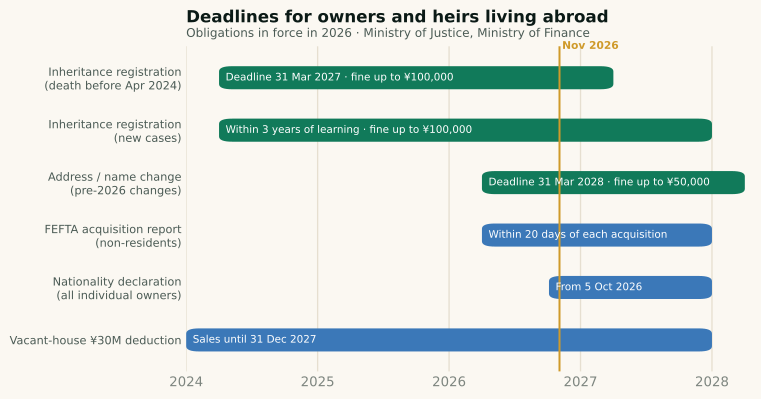
Since 1 April 2024, under Article 76-2 of the amended Real Property Registration Act, anyone who acquires real estate by inheritance must apply for registration within 3 years of learning of it. Failure without a justifiable reason can lead to an administrative fine of up to ¥100,000 (Article 164). The duty is retroactive: for inheritances you learned of before 1 April 2024, the Ministry of Justice sets the deadline at 31 March 2027. It applies regardless of the heir's nationality or where they live.
If the heirs have not yet agreed how to divide the estate, one heir can file a simplified heir declaration registration (相続人申告登記). It satisfies the duty for now, but it does not transfer title, so you still cannot sell until a full inheritance registration is made.
At least one agency page states a ¥50,000 fine for failing to register an inheritance. That figure is the cap for the separate address-change duty below. The inheritance-registration cap is ¥100,000.
Address and name changes (住所等変更登記の義務化)
Since 1 April 2026, registered owners must update a change of address or name within 2 years, with a fine of up to ¥50,000. Changes that occurred before April 2026 must be updated by 31 March 2028. Overseas heirs who left Japan years ago often have outdated addresses on the register, which has to be fixed before a sale.
FEFTA report and nationality declaration
Since 1 April 2026, a non-resident who acquires Japanese real estate, including by inheritance or bequest, must report the acquisition to the Minister of Finance through the Bank of Japan within 20 days, even when the amount is zero. Since 5 October 2026, an heir who registers ownership also declares their nationality to the Legal Affairs Bureau, with a passport or residence-certificate copy; the nationality is not shown on the public register. Owners who live abroad are also asked to register a domestic contact person in Japan.
03 / SELLING FROM ABROAD
Your four options
| Option | Upfront cost | Ongoing burden | Best for |
|---|---|---|---|
| Sell | Registration, brokerage, taxes | None after the sale | Most overseas heirs, especially Tokyo condos at today's prices |
| Rent out | Repairs, management set-up | Tax agent, management fees, 20.42% withholding on rent paid by corporate tenants to a non-resident | Prime Tokyo units with strong rental demand |
| Keep | Fixed-asset tax, upkeep | High; a vacant house deteriorates and can lose its land-tax reduction if designated as poorly managed | Family use |
| Give up | Renunciation within 3 months of learning of the inheritance (covers all assets), or the inherited-land return system (bare land only, building demolished first, fee payable) | — | Unsaleable rural land |
04 / SELLING FROM ABROAD
Step by step: selling without flying to Japan
- Gather the documents. The deceased's family registers (戸籍) from birth to death, the heirs' own registers or birth certificates, and proof of each heir's address and signature. Heirs without a Japanese seal usually substitute a notarised affidavit or a signature certificate from their embassy, with a Japanese translation.
- Agree the division of the estate. The estate division agreement (遺産分割協議書) is signed by all heirs.
- Register the inheritance. The judicial scrivener files under power of attorney. The registration tax is 0.4% of assessed value (NTA No. 7191). Since October 2026 the application carries a nationality declaration; a non-resident heir also files the FEFTA report within 20 days.
- Appoint a tax agent (納税管理人), required for non-resident tax filings.
- Valuation and listing. GAISAPP coordinates the valuation; its licensed partner Livmo markets and brokers the sale.
- Sign and settle remotely. By power of attorney, or with signatures certified at the embassy or consulate. Funds are wired abroad after settlement.
- File a Japanese tax return between 16 February and 15 March of the year after the sale, to settle capital gains tax against the amount withheld.
05 / SELLING FROM ABROAD
Taxes when a non-resident sells
10.21% withholding
According to National Tax Agency Tax Answer No. 2879, a person who buys Japanese land or buildings from a non-resident must withhold 10.21% of the price (income tax plus reconstruction surtax) and pay it to the tax office by the 10th of the following month. There is one exception: an individual buying the property as a home for themselves or their relatives, at a price of ¥100 million or less, does not withhold. From tax year 2027 the withheld amount will also include the new defence special income tax, so the breakdown changes. Withholding is a prepayment, not the final tax: your liability is computed in your return, and any excess is refunded.
Capital gains tax
Taxable gain = sale price − (acquisition cost + selling costs) − special deductions. If the original purchase price cannot be documented, 5% of the sale price may be used as a deemed acquisition cost. The rate depends on ownership at 1 January of the sale year, and for inherited property the deceased's acquisition date and cost carry over to the heir:
The inherited vacant-house deduction (空き家特例)
Under NTA Tax Answer No. 3306, up to ¥30 million can be deducted from the gain (¥20 million per heir if three or more heirs inherited the house, for sales from 1 January 2024). The deduction applies to sales made by 31 December 2027, and the main conditions are: the sale takes place by 31 December of the third year after the death; the price is ¥100 million or less; the deceased lived alone in the house; the house is detached and was built on or before 31 May 1981; and it is made earthquake-compliant or demolished, which since 2024 the buyer may do by 15 February of the following year. Condominium units do not qualify.
Inheritance tax basics
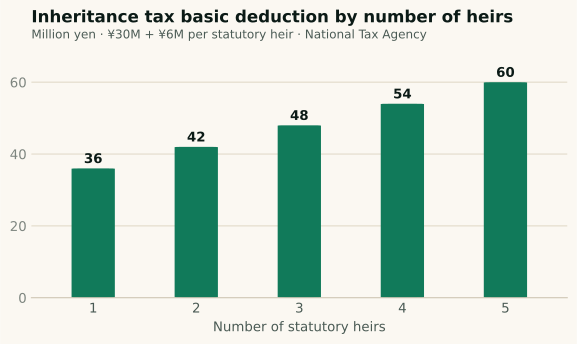
The basic deduction is ¥30 million + ¥6 million per statutory heir; rates are progressive from 10% to 55%; the return is due within 10 months of learning of the death (NTA Tax Answers No. 4152 and 4155). Whether a non-resident heir is taxed on worldwide assets or only on Japanese assets depends on nationality and residence history, so take professional advice.
06 / SELLING FROM ABROAD
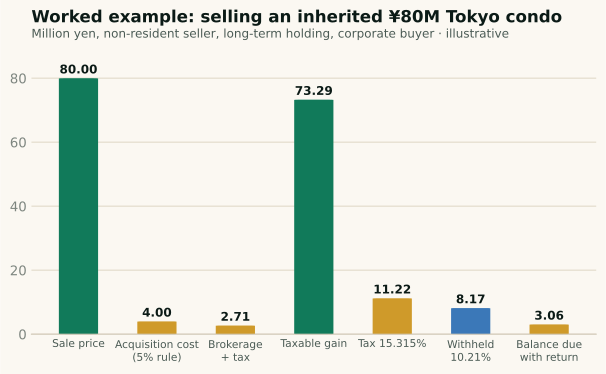
Worked example: selling an inherited ¥80 million Tokyo condo
| Item | Amount |
|---|---|
| Sale price | ¥80,000,000 |
| Acquisition cost (unknown, 5% rule) | ¥4,000,000 |
| Brokerage (3% + ¥60,000 + 10% tax) | ¥2,706,000 |
| Taxable gain | ¥73,294,000 |
| Tax at 15.315% (non-resident, long-term) | ≈ ¥11,225,000 |
| Withheld by a corporate buyer at 10.21% | ¥8,168,000 |
| Balance due with the tax return | ≈ ¥3,057,000 |
| If the buyer is an individual buying a home at ≤ ¥100M | No withholding; full tax paid with the return |
07 / SELLING FROM ABROAD
What is the property worth? Tokyo market context
The value of an inherited Tokyo home depends heavily on ward and building. In September 2026 the 23-ward resale condo asking price (70 m² equivalent) was ¥126.29 million, just off May's record of ¥128.49 million, after four monthly declines (Tokyo Kantei). The central 6 wards stood at ¥177.86 million after five declines. Residential land in the 23 wards rose 8.7–9.0% in 2026's two official surveys, led by Minato at over 16%. The 23-ward new-condo average was ¥136.13 million in 2025 (REEI). With prices this close to the top and asking prices drifting down since June, delaying a sale carries real downside risk; it is a cooling, not a fall, but the direction has changed.
08 / SELLING FROM ABROAD
Japan's akiya problem, and why central Tokyo is the exception
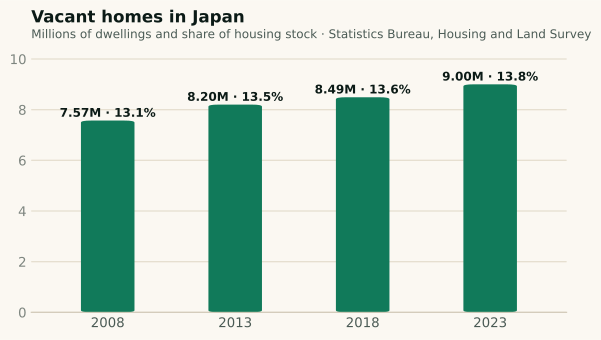
The Statistics Bureau's 2023 Housing and Land Survey (final results, 25 September 2024) counts 9,002,000 vacant homes, 13.8% of all housing, both records, up from 8.49 million (13.6%) in 2018. Of these, 3,856,000 (5.9% of the stock) are "other" vacant homes, meaning not for rent, sale or seasonal use; inherited houses make up much of this category. Rural akiya can be hard to sell at any price, which is why, since 1 July 2024, brokers may charge up to ¥300,000 plus tax on transactions of ¥8 million or less, from both seller and buyer. A neglected house can also be designated as poorly managed, which removes the residential land-tax reduction. Central Tokyo inherited condominiums are the opposite case: they are liquid, in demand from both domestic and overseas buyers, and priced near record highs.
09 / SELLING FROM ABROAD
Frequently asked questions
Do I have to register an inherited property in Japan if I live abroad?
Yes. The obligation applies regardless of nationality or residence. The deadline is 3 years after learning of the inheritance, or 31 March 2027 for inheritances before April 2024, and the fine is up to ¥100,000.
Can I sell Japanese property without going to Japan?
Yes. Use a power of attorney with a judicial scrivener, a licensed broker and a tax agent, with signatures notarised at an embassy or consulate.
What tax does a non-resident pay when selling property in Japan?
The buyer usually withholds 10.21% of the price. The final capital gains tax is 15.315% (national, long-term) or 30.63% (short-term) for most non-residents, settled in a Japanese tax return.
Does the ¥30 million vacant-house deduction apply to inherited condos?
No. It applies only to detached houses built on or before 31 May 1981 that the deceased lived in alone, among other conditions, for sales by 31 December 2027.
How much is the inheritance tax basic deduction in Japan?
¥30 million plus ¥6 million per statutory heir; for example ¥48 million for three heirs.
What if I don't want the inherited house?
You can renounce the whole inheritance within 3 months of learning of it, or, for bare land after demolition, use the inherited-land return system.
What is an heir declaration registration?
A simplified filing by one heir that satisfies the registration duty but does not transfer title.
How long does selling from abroad take?
Plan for several months. Collecting family registers and registering the inheritance usually takes longer than the sale itself.
Sources and methodology
This article is general information, not legal or tax advice. Non-resident liability for local inhabitant tax, the carry-over of holding periods, tax-treaty relief and the 2027 defence surtax should be confirmed with a Japanese licensed tax accountant before you act. Figures are correct to the best of our knowledge as of 5 November 2026.
- [1]Ministry of Justice, mandatory inheritance registration (3 years, ¥100,000, 31 March 2027)moj.go.jp/MINJI/souzokutouki-gimuka/
- [2]Ministry of Justice, real property registration reforms and heir declaration registrationmoj.go.jp/MINJI/minji05_00435.html
- [3]Ministry of Justice, Ordinance No. 23 of 2026 (nationality declaration from 5 October 2026)moj.go.jp/content/001470076.pdf
- [4]Ministry of Finance, FAQ on FEFTA acquisition reports, including inheritancemof.go.jp/…/FAQ_J.pdf
- [5]Ministry of Finance, FEFTA reporting overviewmof.go.jp/…/seido_gaiyo.html
- [6]National Tax Agency, Tax Answer No. 2879, 10.21% withholding on purchases from non-residentsnta.go.jp/…/gensen/2879.htm
- [7]National Tax Agency, Tax Answer No. 1440, capital gains on real estatenta.go.jp/…/joto/1440.htm
- [8]National Tax Agency, Tax Answer No. 3306, inherited vacant-house deductionnta.go.jp/…/joto/3306.htm
- [9]National Tax Agency, Tax Answer No. 4152, inheritance tax computationnta.go.jp/…/sozoku/4152.htm
- [10]National Tax Agency, Tax Answer No. 4155, inheritance tax ratesnta.go.jp/…/sozoku/4155.htm
- [11]National Tax Agency, Tax Answer No. 7191, registration tax 0.4% on inheritancenta.go.jp/…/inshi/7191.htm
- [12]Statistics Bureau, 2023 Housing and Land Survey, vacant homes 9.00 million (13.8%)stat.go.jp/data/jyutaku/2023/
- [13]MLIT, Notice No. 949 of 2024, brokerage fee special rule for low-price propertymlit.go.jp/…/001750937.pdf
- [14]Tokyo Kantei via Kyodo/Kumanichi, 23-ward resale price September 2026kumanichi.com/articles/2049317
- [15]REEI via nippon.com, 23-ward new condo average 2025nippon.com/ja/japan-data/h02685/
- [16]Tokyo Metropolitan Government, prefectural land price survey 2026metro.tokyo.lg.jp/…/2026091022
- [17]Japan Law Translation, Real Property Registration Act (Articles 76-2, 164)japaneselawtranslation.go.jp/en/laws/link/2030