

00 / MARKET ANALYSIS
Key takeaways
- Prime Tokyo is priced at par with Western capitals. Savills values it at US$2,680 per sq ft, slightly above New York (2,610) and well above London (2,030) and Paris (1,980) [1].
- The yen helps less than it looks. A dollar buys about twice as many yen as in 2012, but the average new 23-ward condo also doubled in yen since 2015 [4][9].
- Ownership rules are open. Any nationality can buy freehold, with no residency requirement and no foreign-buyer surcharge [11].
- 2026 brought reporting, not restrictions. Non-residents file a FEFTA report within 20 days; every buyer declares nationality at registration [11][12].
- Yields are thin. Treat Tokyo luxury as a store of wealth and a place to live, not an income play [17].
- The cycle is maturing. 23-ward resale prices fell for four months in a row to September 2026 [6].
Prime Tokyo value per m²
Savills, Feb 2026 (US$2,680/sq ft)
Average new condo, 23 wards, 2025
REEI, double the 2015 level
Bank of Japan policy rate
Since 18 Sep 2026, highest in 31 years
Average gross rental yield, Tokyo
Global Property Guide, Q1 2026
01 / MARKET ANALYSIS
Is Tokyo luxury real estate cheap for Americans and Europeans in 2026?
No, not at the prime end. Prime Tokyo costs about the same per square metre as prime New York and more than prime London or Paris. The value lies in what the money buys: safety, transport, build quality and open ownership rules.
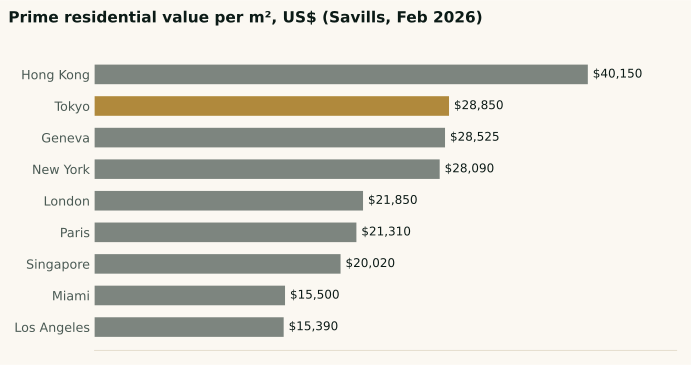
Two benchmarks disagree on Tokyo’s exact rank, but agree on the direction. Savills places Tokyo second of 30 cities by value and first for growth in 2025 (+30.1%) [1]. In Knight Frank’s Wealth Report, US$1 million bought 62.4 m² of prime Tokyo in Q4 2020 but only 36.6 m² in Q4 2025, a 41% fall in dollar purchasing power. The same sum bought 33.9 m² in New York, 32.9 m² in London and 37.1 m² in Paris [3].
| City | Savills, US$/sq ft | ≈ US$/m² | Knight Frank: m² per US$1m (Q4 2025) |
|---|---|---|---|
| Hong Kong | 3,730 | 40,150 | — |
| Tokyo | 2,680 | 28,850 | 36.6 |
| Geneva | 2,650 | 28,525 | — |
| New York | 2,610 | 28,090 | 33.9 |
| London | 2,030 | 21,850 | 32.9 |
| Paris | 1,980 | 21,310 | 37.1 |
The indices measure different things: Savills tracks a defined prime stock, Knight Frank the top 5% of each market. Neither is definitive. For a buyer, the point is that the “cheap Tokyo” story of 2020 is over. The decision should now rest on use, security and long-term holding, not on a currency discount.
02 / MARKET ANALYSIS
How much have Tokyo condo prices risen in the last 10 years?
The average new condominium in Tokyo’s 23 wards roughly doubled, from ¥67.32 million in 2015 to ¥136.13 million in 2025, according to the Real Estate Economic Institute (不動産経済研究所, REEI) [4][5]. Most of the rise came after 2022, as land, construction and labour costs climbed and developers shifted to large central towers.
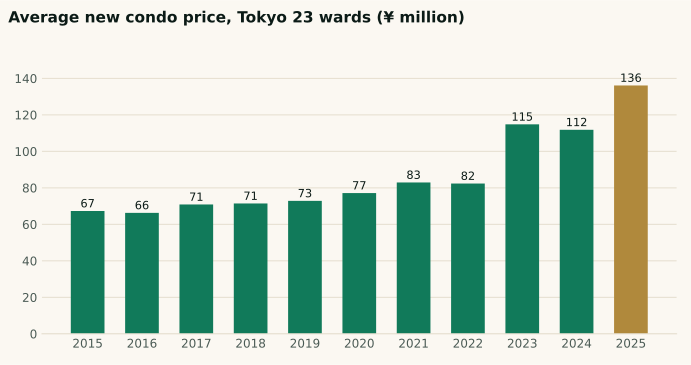
At the top of the market, Knight Frank recorded a 58.5% rise in prime new-build values in 2025 [3]. Savills measured a further 7.0% rise in Tokyo prime values in the first half of 2026 and 20.4% over the twelve months to June, calling Tokyo the standout market of the Asia-Pacific region [2].
The first signs of cooling
Resale prices have stopped rising. Tokyo Kantei’s 70 m² asking price for the 23 wards fell for a fourth month in a row to ¥126.29 million in September 2026, after a long run of record highs [6][7]. Contracts are slowing while asking prices stay high. That usually signals a more negotiable market rather than a crash.
03 / MARKET ANALYSIS
How does the weak yen change the maths for dollar and euro buyers?
A dollar buys about twice as many yen as in 2012. Because yen prices rose sharply too, the net discount on prime Tokyo has largely disappeared since 2020.
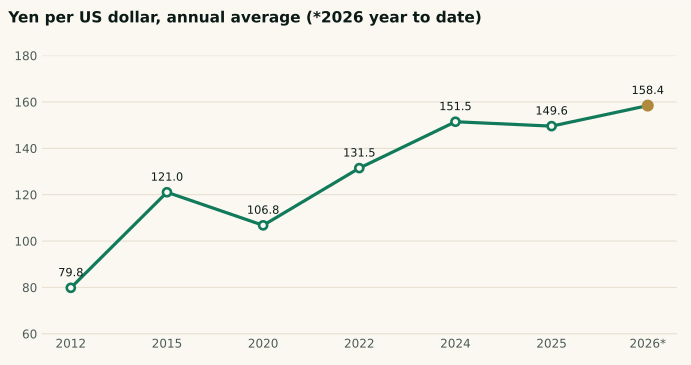
- The average new 23-ward condo cost about US$556,000 in 2015 (at ¥121.05) and about US$910,000 in 2025 (at ¥149.57): +64% in dollars against +102% in yen.
- A ¥500 million Minato residence costs about US$3.15 million at ¥158.7 per dollar, against about US$4.7 million at the 2020 average of ¥106.8.
- The risk runs both ways. If the Bank of Japan keeps raising rates and the yen recovers, a dollar or euro holder gains. If you must sell when the yen is weaker still, a gain in yen can shrink once converted.
04 / MARKET ANALYSIS
Can foreigners buy property in Japan? The 2026 rules
Yes. Foreigners of any nationality can buy freehold land and buildings on the same legal terms as Japanese citizens, with no visa, residency, minimum spend or prior approval.
- Since 1 April 2026, a non-resident who acquires Japanese real estate, including a home for personal use, files a report with the Minister of Finance through the Bank of Japan within 20 days [11].
- Since 5 October 2026, every new owner declares nationality at registration. It is held internally and does not appear on public extracts [12].
- Not changed: there is no ban or cap on foreign purchases of ordinary homes. Owning property does not grant a visa.
For the full process, see our guide Can foreigners buy property in Tokyo? The 2026 rules, costs and process.
05 / MARKET ANALYSIS
What does it cost to buy, own and sell a luxury condo in Tokyo?
For a cash purchase of a resale luxury condo, budget about 4–5% of the price in purchase costs; with a mortgage, closer to 6–9%. The example below assumes assessed values of ¥40 million for the land and ¥20 million for the building.
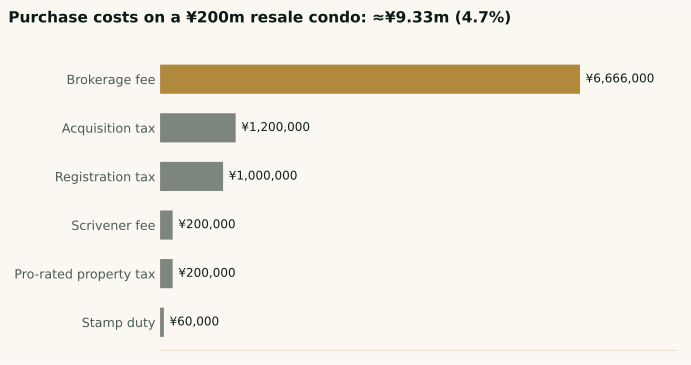
- Every year: fixed asset tax (usually 1.4%) and city planning tax (usually 0.3%) on assessed value, plus management fees and repair reserves, which rise with the building’s age.
- On sale: non-residents pay 15.315% on gains from property held over five years and 30.63% within five years. The buyer withholds 10.21% of the gross price and pays it to the tax office [14].
- On rent: 20.42% is withheld from rent paid to non-resident owners.
- On death: Japanese real estate is always within Japan’s inheritance tax (top rate 55%). Japan has an estate and gift tax treaty only with the United States, so European owners should plan before buying.
06 / MARKET ANALYSIS
Mortgage rates in Japan vs the US
| Indicator | Rate | Date |
|---|---|---|
| Bank of Japan policy rate | 1.25% | 18 Sep 2026 [8] |
| Japan variable mortgage, lowest megabank offers | ≈1.2–1.5% | Oct 2026 |
| US 30-year fixed | 7.18% | 5 Nov 2026 [16] |
| US 15-year fixed | 6.57% | 5 Nov 2026 [16] |
Japan remains the cheapest major market to borrow in, but rates are rising. Japanese bank mortgages generally require residency and local income, so most non-residents pay cash or use specialist lenders at higher rates.
07 / MARKET ANALYSIS
Luxury rentals in Tokyo: what do prime areas cost?
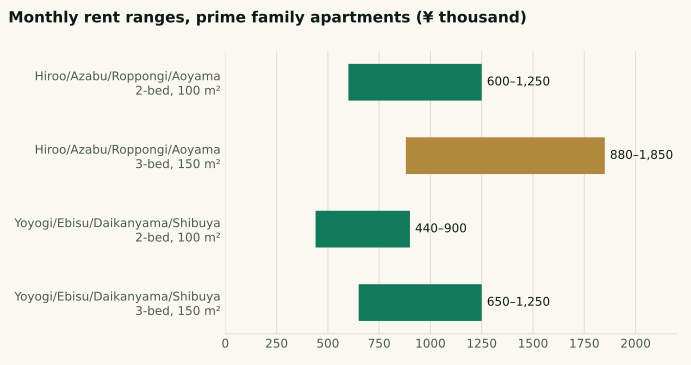
A 100 m² two-bedroom in Hiroo, Azabu, Roppongi or Aoyama typically rents for ¥600,000–¥1,250,000 a month (about US$3,800–7,900). A 150 m² three-bedroom typically rents for ¥880,000–¥1,850,000 [18].
For Western renters, prime Tokyo offers more space per dollar than central Manhattan or Mayfair. Leases usually run two years, and corporate tenants often negotiate key money and deposits. Before you commit, read our Tokyo rental costs guide and rental application guide, or see current luxury rentals in Tokyo.
08 / MARKET ANALYSIS
Yields, demand and what “luxury” means in Tokyo
Yields are low. Tokyo’s average gross rental yield is 3.27%, and 2.81% for a central one-bedroom [17]. Net yields are typically 1.5–2 points lower after costs. Buy for capital preservation and use, not income.
Foreign demand is real but often overstated. Buyers registered at an overseas address took 3.5% of new condos in the 23 wards in the first half of 2025, and 7.5% in the central six wards [19]. Foreign residents in Japan and companies with foreign capital are not counted, so the true share is higher. Tokyo had 783,701 foreign residents on 1 January 2026 [20].
Luxury in Tokyo means engineering and service more than size. Buildings permitted under the 1981 seismic standard, and especially after the 2000 revision, are built for major earthquakes; premium towers often add seismic isolation or damping. A 120–150 m² unit is a large family home in Minato. Very low crime, a dense rail network and international schools around Minato, Shibuya and Meguro complete the case. Compare neighbourhoods in our area guides.
09 / MARKET ANALYSIS
Risks, and a buy-or-rent framework
- Currency: a further yen fall reduces what you take home in dollars or euros.
- Interest rates: variable-rate payments follow the Bank of Japan’s hikes.
- Valuation: UBS’s Global Real Estate Bubble Index ranks Tokyo among the highest-risk cities [21].
- Natural hazards: check earthquake, flood and liquefaction maps at the exact address.
- Liquidity and building age: older buildings and secondary locations sell slowly.
- Exit tax: selling within five years doubles the capital gains rate for non-residents.
| Your situation | Lean towards |
|---|---|
| Living in Tokyo 5+ years, holding dollars or euros, able to pay cash | Buy in a prime, post-2000 building with strong management |
| Staying under 5 years, employer pays housing, or avoiding currency and exit-tax risk | Rent: with yields near 3%, renting is often cheaper per year of use |
| Unsure about neighbourhood or schools | Rent first, then buy once you know the micro-location |
10 / MARKET ANALYSIS
Frequently asked questions
Can foreigners buy property in Japan?
Yes. Any nationality can buy freehold land and buildings with the same rights as Japanese citizens. No visa or residency is required.
Can an American buy an apartment in Tokyo?
Yes, on identical terms. US citizens also benefit from the US–Japan estate and gift tax treaty, the only one of its kind Japan has signed.
Does buying property in Japan give me residency?
No. Property ownership does not grant a visa or count toward one.
How much does a luxury apartment in Tokyo cost?
The average new condo in the 23 wards was ¥136.13 million in 2025, about US$860,000 at ¥158.7 per dollar. Prime units in Minato trade far higher; Savills values prime Tokyo at about US$28,850 per m².
Is Tokyo property cheaper than New York, London or Paris?
At the prime level, not any more. Savills puts Tokyo at US$2,680 per sq ft against New York’s 2,610, London’s 2,030 and Paris’s 1,980.
How much is rent for a luxury apartment in Tokyo?
In Hiroo, Azabu, Roppongi and Aoyama, a 100 m² two-bedroom typically rents for ¥600,000–¥1,250,000 a month, and a 150 m² three-bedroom for ¥880,000–¥1,850,000.
What taxes do foreigners pay on Japanese property?
Acquisition and registration taxes on purchase; fixed asset and city planning tax each year; income tax on rent (20.42% withheld for non-residents); capital gains tax on sale (10.21% of the price withheld for non-residents); and inheritance tax on Japanese assets.
Is now a good time to buy in Tokyo?
Prices are at record levels, resale prices have started to ease and rates are rising. That favours selective, long-term buyers over short-term speculation. We do not forecast returns.
Sources and methodology
This article is general information, not legal, tax, investment or immigration advice. Figures were consulted between 1 and 11 November 2026 and may change. Savills, Knight Frank and UBS use their own definitions, so their figures are not directly comparable. Currency conversions and the cost example are GAISAPP calculations on the assumptions stated. Past price growth does not predict future returns.
- [1]Savills, 2026 World Cities Prime Residential Index (Feb 2026)pdf.savills.com/World+…/World+Research+-+World+C
- [2]Savills, World Cities: Asia Pacific, 19 Aug 2026savills.co.uk/research_articles/226576/393851-0
- [3]Knight Frank, The Wealth Report 2026, via Relocate Magazine (23 Apr 2026)relocatemagazine.com/g…/global-luxury-house-pric
- [4]REEI via nippon.com, 23-ward new condo average 2025nippon.com/ja/japan-data/h02685/
- [5]REEI historical series, PR Times compilationprtimes.jp/main/html/r…/000000004.000171669.html
- [6]Tokyo Kantei via Kyodo/Kumanichi, 23-ward resale price, September 2026kumanichi.com/articles/2049317
- [7]Tokyo Kantei via Kyodo/Kumanichi, 23-ward resale price, August 2026kumanichi.com/articles/2039027
- [8]Kyodo/Kumanichi, Bank of Japan raises policy rate to 1.25% (Sep 2026)kumanichi.com/articles/2037289
- [9]Federal Reserve G.5A, USD/JPY annual average (FRED AEXJPUS)fred.stlouisfed.org/series/AEXJPUS
- [10]Macrotrends, USD/JPY historical chart (2026 year to date)macrotrends.net/2550/d…/dollar-yen-exchange-rate
- [11]Ministry of Finance, FEFTA real-estate acquisition reportingmof.go.jp/policy/inter…/seido_gaiyo.html
- [12]Ministry of Justice, Ordinance No. 23 of 2026 (nationality at registration)moj.go.jp/content/001470076.pdf
- [13]National Tax Agency, Tax Answer No. 7191 (registration and licence tax)nta.go.jp/taxes/shirab…/7191.htm
- [14]National Tax Agency, Tax Answer No. 2879 (withholding on purchases from non-residents)nta.go.jp/taxes/shirab…/2879.htm
- [15]MLIT, brokerage fee caps (Notice No. 949 of 2024)mlit.go.jp/totikensang…/001750937.pdf
- [16]Freddie Mac, Primary Mortgage Market Survey (5 Nov 2026)freddiemac.com/pmms
- [17]Global Property Guide, Japan rental yieldsglobalpropertyguide.com/asia/japan/rental-yields
- [18]All Japan Relocation, Tokyo expat areas and housing ratesalljapanrelocation.com…/tokyo-housing-rates
- [19]MLIT via nippon.com, overseas-address buyers of new condos, H1 2025nippon.com/ja/japan-data/h02624/
- [20]Tokyo Metropolitan Government, foreign residents on 1 January 2026metro.tokyo.lg.jp/info…/2026032310
- [21]UBS, Global Real Estate Bubble Indexubs.com/global/en/weal…/global-real-estate-bubbl