
GAISAPP market insight · July 2026
Tokyo Policy Signals Support Long-Term Real EstateTokyo Policy Signals Support Long-Term Real Estate
A source-linked GAISAPP market note on how Japan’s 2026 growth policy, financial-center strategy, urban resilience and capital-market liquidity support Tokyo’s long-term property confidence.A source-linked GAISAPP market note on how Japan’s 2026 growth policy, financial-center strategy, urban resilience and capital-market liquidity support Tokyo’s long-term property confidence.

Citation policy
Paragraph-level markers such as [1] link directly to the source list. Image credits are included in the same source section.
Tokyo is not rising only because of market momentum. In 2026, the political and policy environment is increasingly aligned around growth capital, financial-market reform, urban resilience, sustainability, international talent and tourism-led service demand.[1][2][8]
For long-horizon real estate investors, policy matters because it can improve the city’s ability to attract people, companies, capital and institutional liquidity over time. It does not guarantee returns, but it can strengthen the demand base behind well-selected property.[1][8]
01 · Growth-capital mobilizationJapan is shifting from defensive stability to investment policy
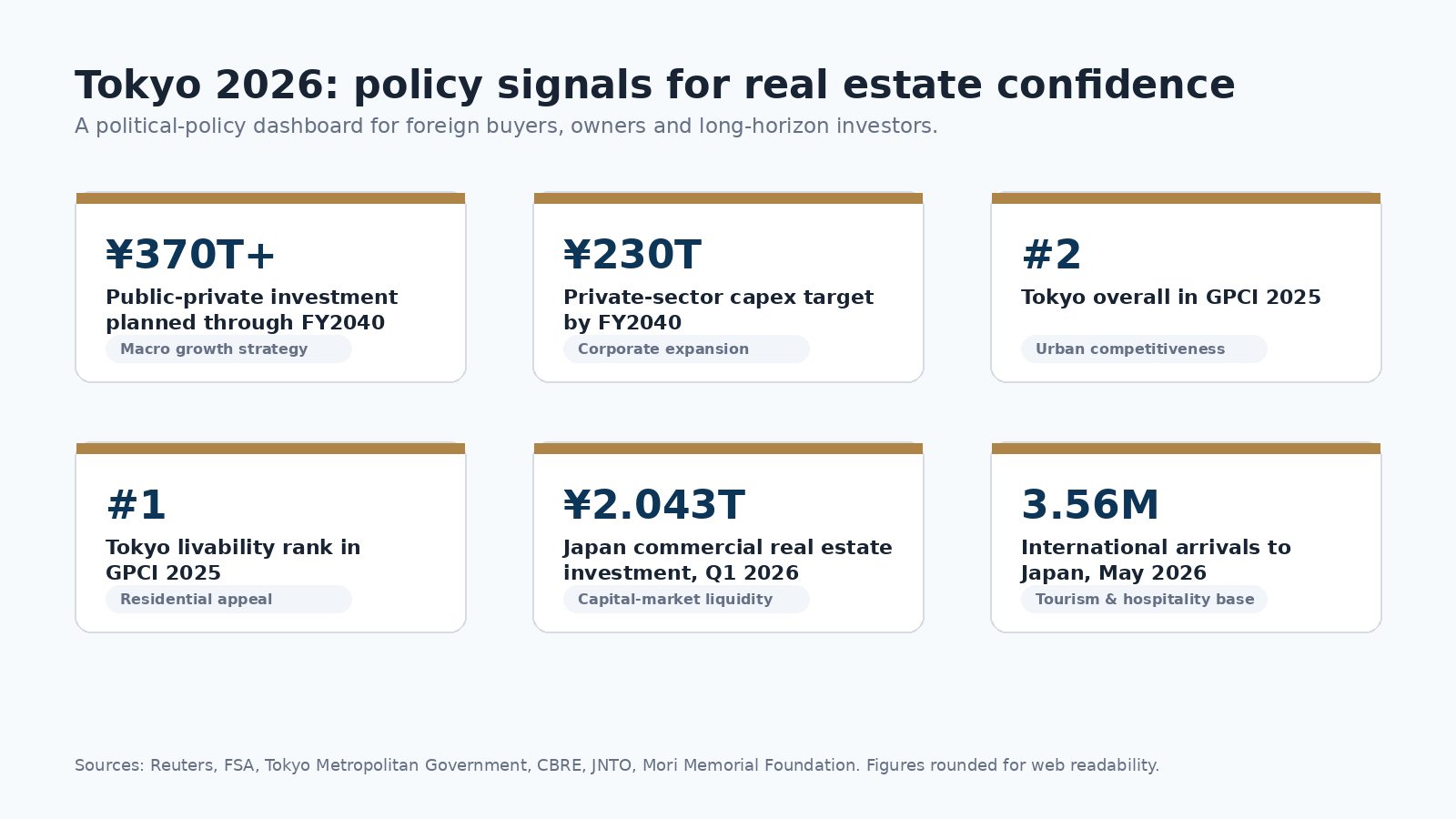
Reuters reported that Japan’s 2026 economic blueprint aims for real growth above 1% and nominal growth above 3%, while targeting more than ¥370 trillion in combined public-private investment through FY2040. That is a pro-investment signal for Tokyo as Japan’s administrative, financial and corporate center.[1]
02 · Financial gatewayTokyo is being positioned as a capital platform
The FSA’s Japan Weeks 2026 page states that the government is advancing initiatives to establish Japan as an international financial center and promote Japan as a leading asset management center. The FSA’s special-zone framework also names Tokyo as one of the designated areas.[2][3]
03 · Soft infrastructureTokyo is reducing friction for foreign companies and residents
Invest Tokyo highlights support channels such as overseas consultation desks, the Business Development Center Tokyo, the Tokyo One-Stop Business Establishment Center, startup visa support, employment consultation and support for foreign financial companies. For buyers, this matters because a residence is often part of a wider operating base.[4]
04 · Urban resilienceLong-term planning supports asset quality
The 2050 Tokyo Strategy and green/resilience projects show that Tokyo’s policy horizon extends beyond office supply. For owners, infrastructure renewal, heat countermeasures, public-space quality and environmental planning can support the long-term livability of central neighborhoods.[5]
05 · Market evidenceCapital-market activity confirms confidence
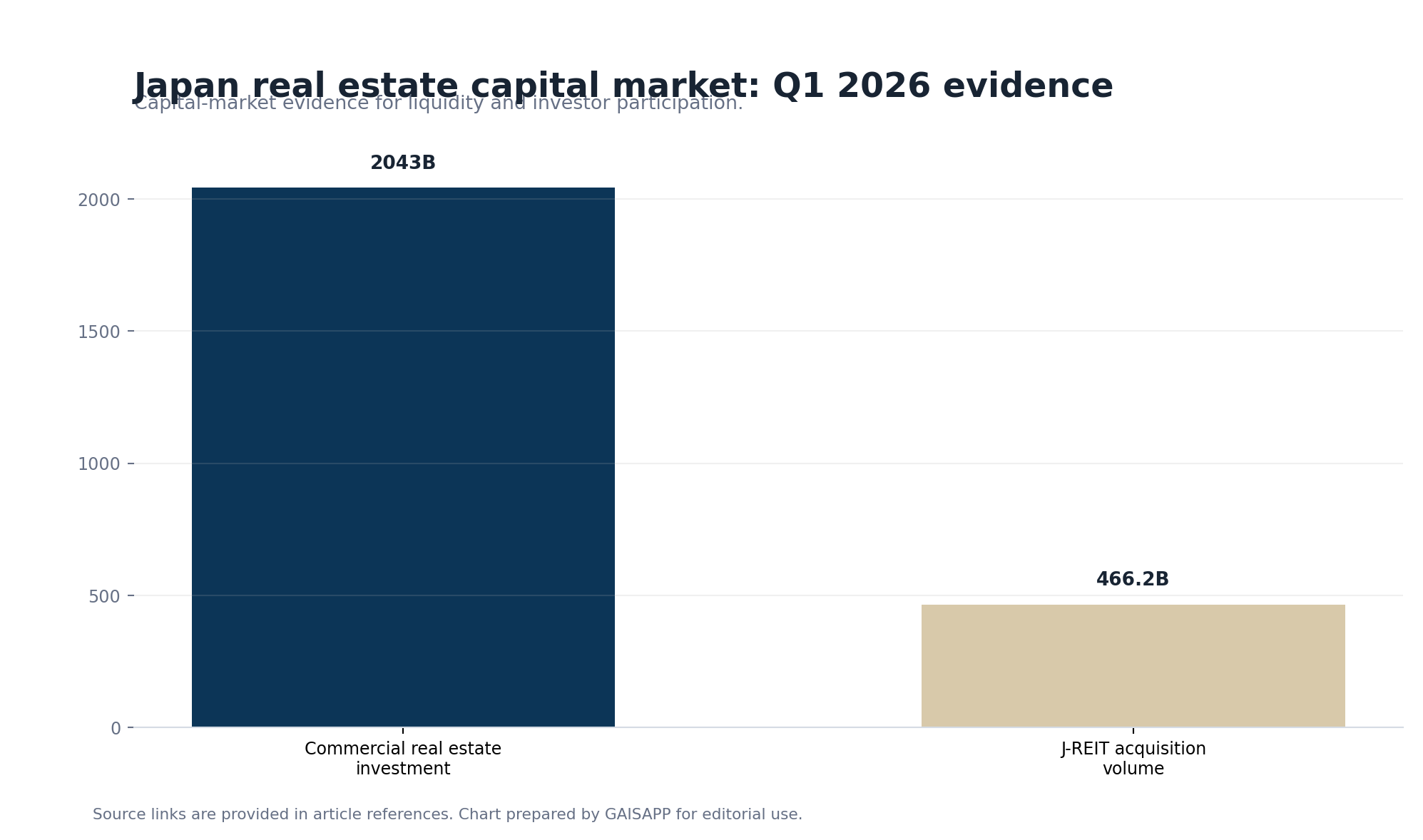
CBRE reported that Japan commercial real estate investment volume reached ¥2.043 trillion in Q1 2026, a record high for a first quarter, while overseas investors remained active and J-REIT acquisition volume reached ¥466.2 billion.[8]
06 · FlywheelPolicy does not replace due diligence — it improves the context
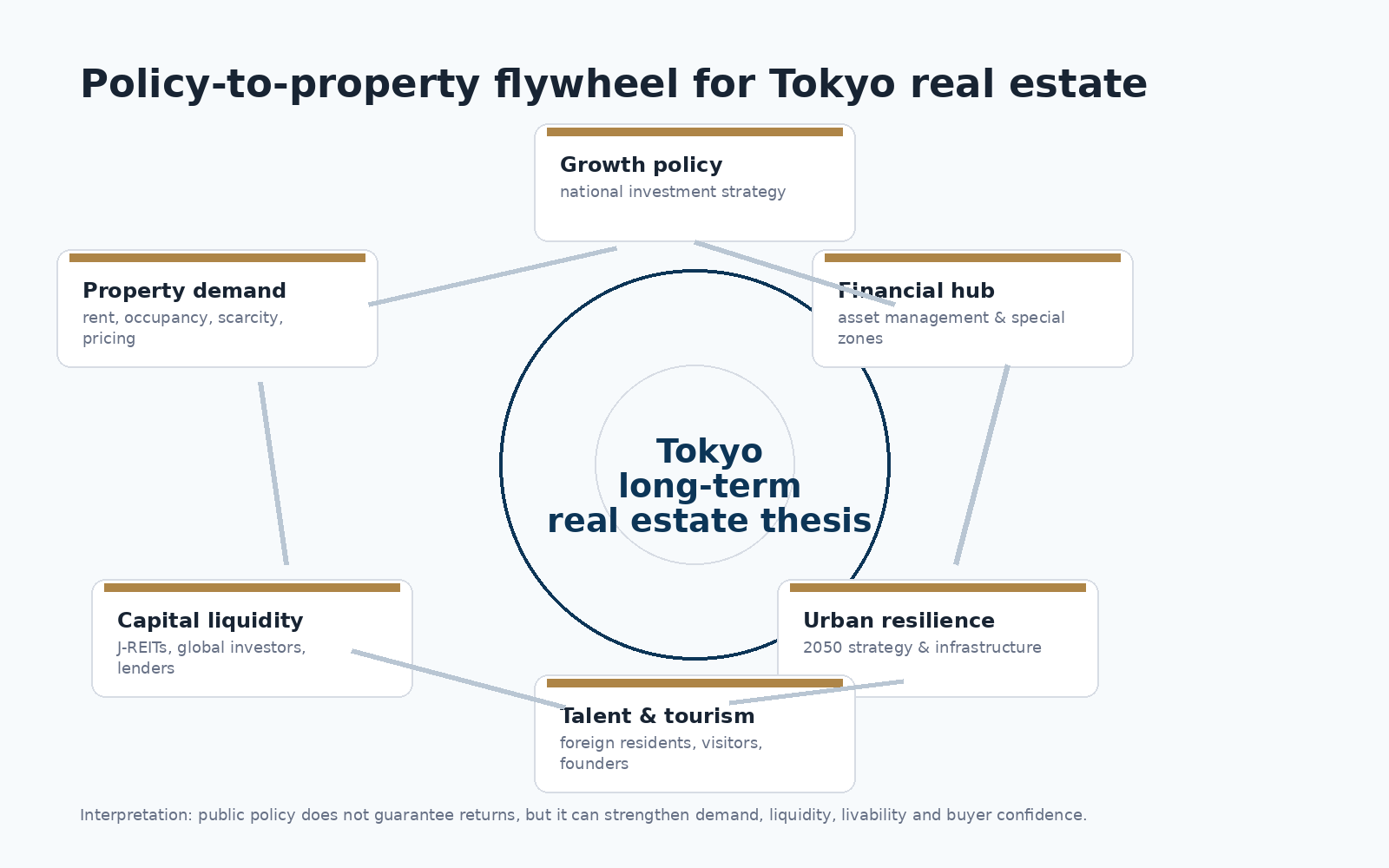
The strongest interpretation is not “buy anything in Tokyo.” It is that Tokyo’s best assets sit inside a reinforcing system: national growth policy, financial-center initiatives, urban resilience, global visibility, tourism demand and active capital markets. Selection, legal confirmation and asset-level due diligence remain essential.[6][7][8]
Tokyo is a long-term policy-and-capital platform.
GAISAPP helps foreign buyers, owners and investors turn macro signals into asset-level decisions: ward, building, legal status, tenant logic and exit story.
Discuss a Tokyo strategySources and reference links
- Reuters, Japan targets more than doubling real growth to over 1% in economic blueprint
- FSA, Japan Weeks 2026
- FSA, Special Zones for Financial and Asset Management Businesses
- Tokyo Metropolitan Government, Invest Tokyo
- Tokyo Metropolitan Government, 2050 Tokyo Strategy
- Mori Memorial Foundation, Global Power City Index 2025
- JNTO, visitor arrivals to Japan, May 2026
- CBRE, Japan Investment MarketView Q1 2026
- Reuters, Japan business mood hits 8-year high, July 2026
- Pexels License — free stock photo and video license
- Hero image credit: Alexander London, via Pexels