
LIVING IN JAPAN / MARKET INSIGHT · 6 JULY 2026
Japan's Quiet Reawakening: World-Class Living, Unexpected Value and a New Economic Cycle日本の静かな再始動:世界水準の暮らし、相対的な価値、そして新しい経済サイクル
Tokyo combines top-tier urban quality with housing costs that still compare favourably with many peer cities. At the same time, Japan is moving from decades of deflationary caution toward a new cycle of wages, investment and international demand.東京は世界水準の都市機能と、主要都市と比べてなお相対的な価値を持つ住宅市場を併せ持つ。同時に、日本経済は長い慎重姿勢から、賃金・投資・国際需要が動く新しい局面へ移りつつあります。
How to read this article
This is not a “Japan is cheap” slogan or a prediction of an economic boom. The analysis separates current evidence from policy targets and asks where world-class lifestyle value, urban concentration and new investment demand genuinely overlap.
For years, Japan has been described through contradictions: technologically advanced yet slow-growing, globally admired yet economically cautious, expensive in reputation yet surprisingly moderate in many parts of daily life. In 2026, those contradictions are becoming more important for people deciding where to live, work, build a business or hold property.
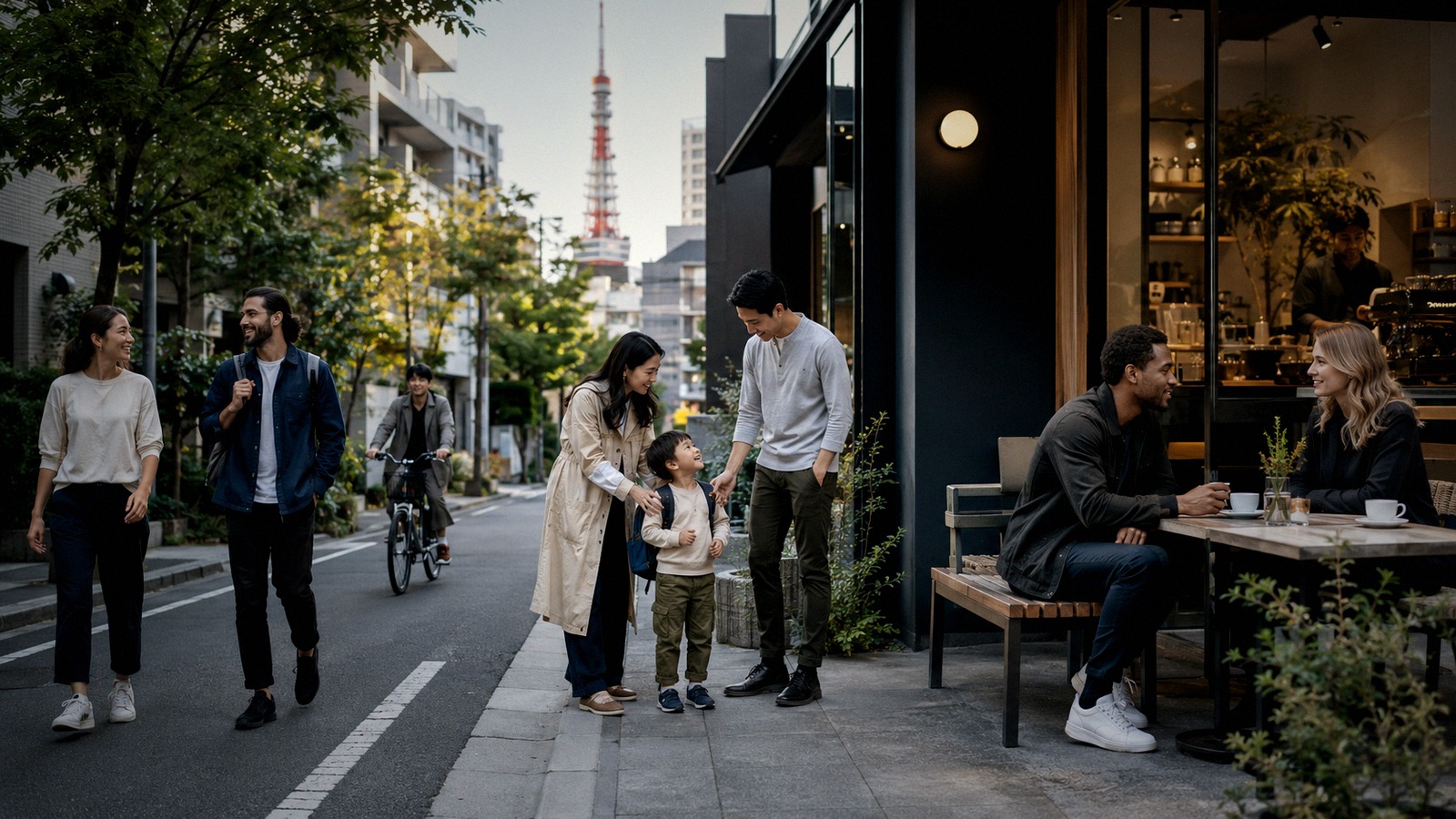
Tokyo now sits at the top of Monocle's 2026 Quality of Life Survey. Separately, the Mori Memorial Foundation's Global Power City Index 2025 placed Tokyo second overall and first in Livability. Rankings differ in methodology, but together they reinforce a broader point: Tokyo is not merely large. It is a deeply functional global city.[1][2]
The investment case, however, should not be built on a slogan. Japan is not suddenly a high-growth economy, and Tokyo is not uniformly cheap. The more credible thesis is subtler: world-class urban utility still meets a relative value gap in selected segments, while wages, strategic investment, tourism and foreign capital are creating new demand channels. That combination deserves attention — and selectivity.
01 · VALUE DENSITYJapan's advantage is not “cheapness” — it is how much daily utility the system delivers
A useful way to think about Japan is not to ask whether it is cheap in absolute terms. The better question is how much everyday utility a household receives for the total cost of living: transport access, safety, healthcare protection, service reliability, food, public space, retail access and the amount of time lost to friction.
Monocle's Tokyo analysis highlights the city's safety, late-night activity and dense transport access; it reports that about 84% of the area inside Loop Road No. 7 is within a ten-minute walk of a train station. This is an editorial survey rather than an official transport census, but it captures an everyday reality with economic value: access reduces time costs and expands the number of jobs, schools, services and neighborhoods reachable without a car.[1]
The cost of mobility is also unusually legible. Tokyo Metro regular tickets are distance-based and currently range from ¥180 to ¥330. A resident does not buy a home only in square metres; in Tokyo, a large part of residential value is the network of destinations that can be reached reliably from the nearest station.[4]
Healthcare is another component that simple rent comparisons miss. Under Japan's insured medical framework, people aged 6 to 69 generally pay 30% of covered medical expenses at the point of service, with other rates applying by age and income. Premiums, taxes and non-covered services remain separate, but the framework changes the household risk profile compared with systems that require much larger direct exposure.[5]
A better comparison
Do not compare rent alone. Compare total lifestyle value: housing + mobility + time + healthcare exposure + safety + the private spending required to compensate for weak public systems.
02 · GLOBAL HOUSING GAPA relative-value gap still exists — but Tokyo is already repricing
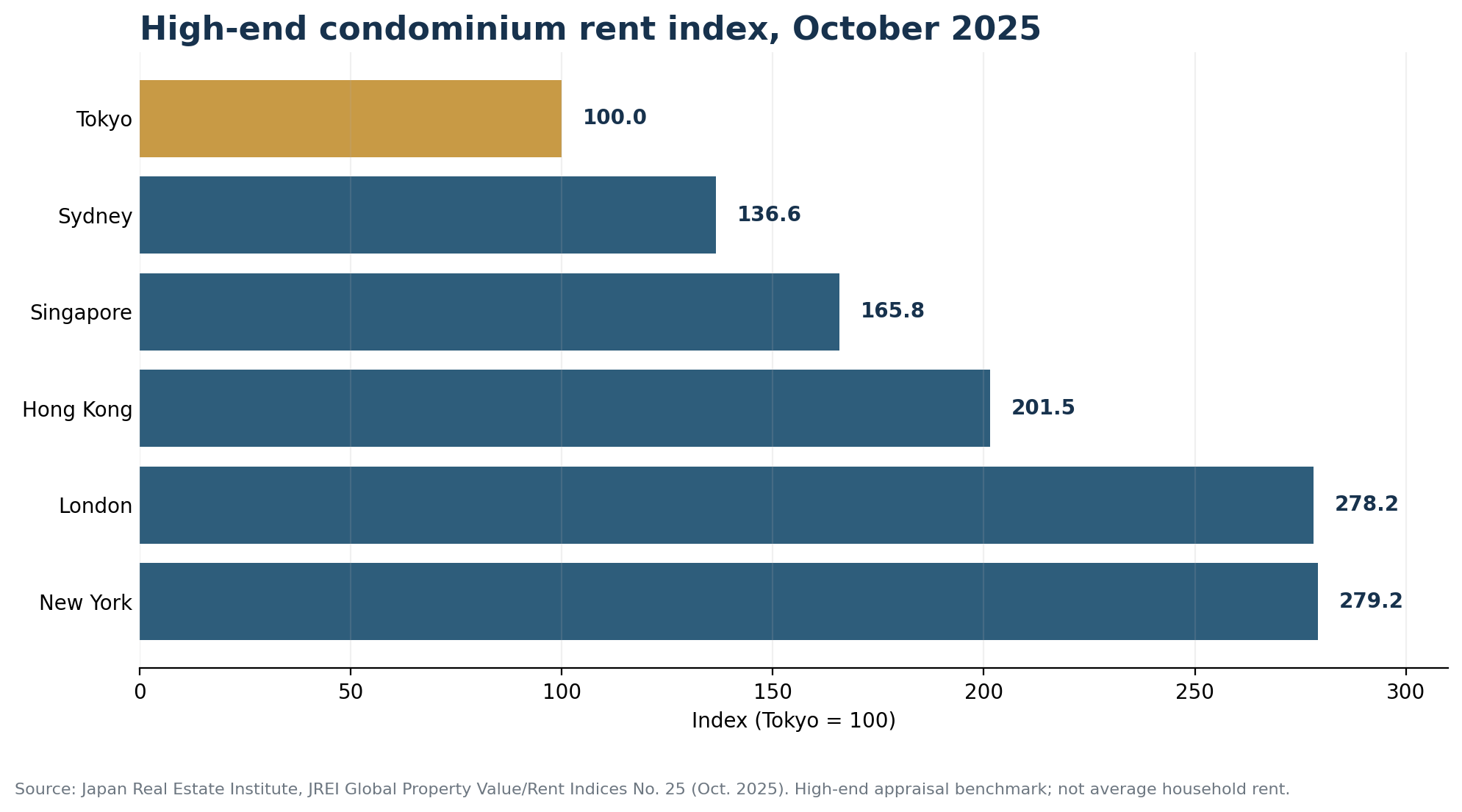
The strongest evidence for Tokyo's relative housing value comes from clearly defined market benchmarks rather than broad cost-of-living anecdotes. In the Japan Real Estate Institute's October 2025 high-end condominium rent comparison, Tokyo's Moto-Azabu benchmark is set at 100. Sydney stood at 136.6, Singapore at 165.8, Hong Kong at 201.5, London at 278.2 and New York at 279.2.[3]
The caveat matters. This is a high-end appraisal benchmark across specified assets and cities; it is not an average-rent index for ordinary households. Currency movements also affect the yen-converted comparison. Still, for international clients comparing prime urban lifestyles, the gap is too large to dismiss.
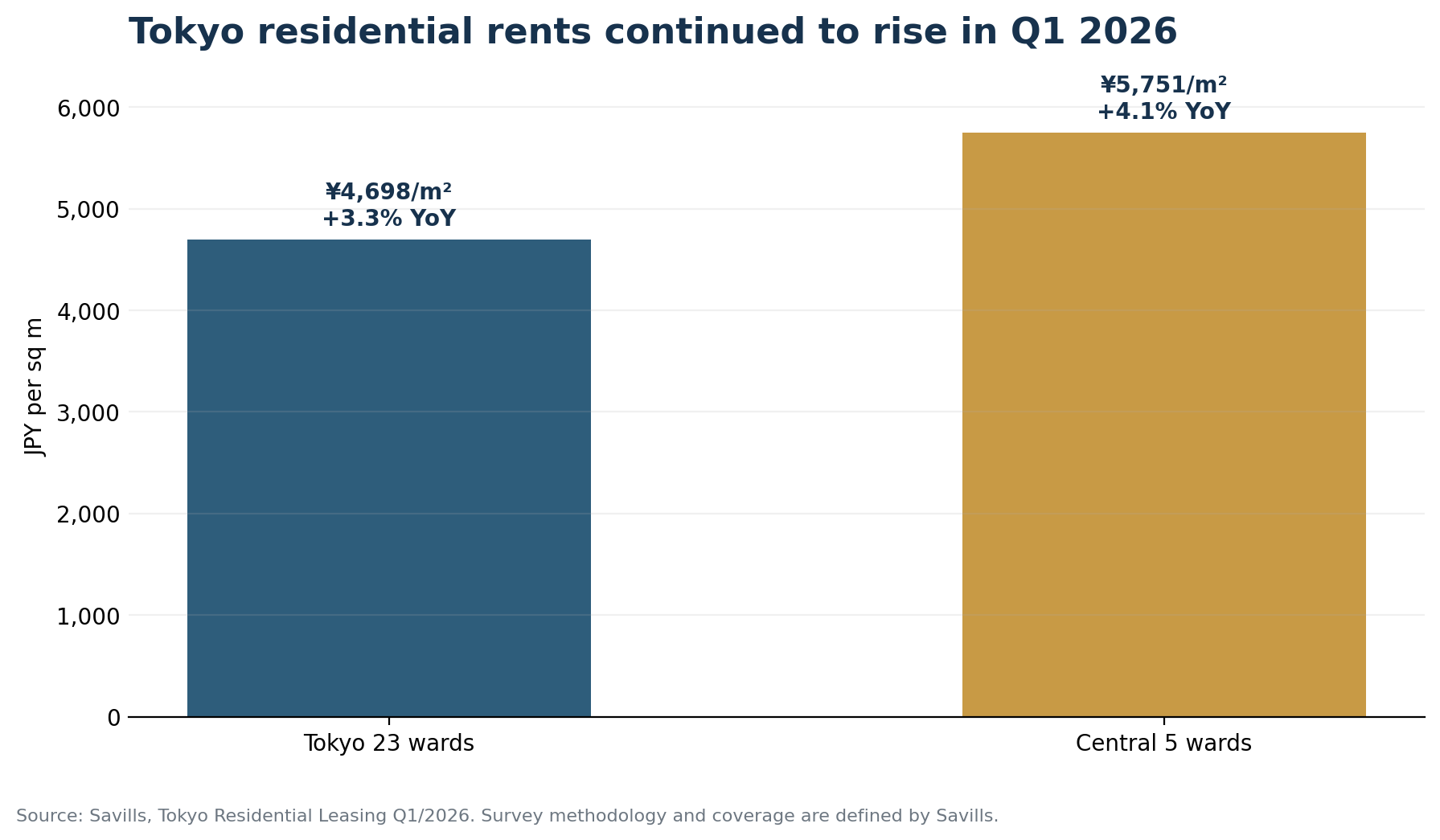
The value gap is not static. Savills reported that average rents in its Tokyo 23-ward survey universe reached ¥4,698 per square metre in Q1 2026, up 3.3% year on year. In the central five wards, average rents reached ¥5,751 per square metre, up 4.1% year on year. Tokyo can still look relatively inexpensive beside peer cities while becoming more expensive on its own terms.[13]
The practical implication
Good value today does not mean guaranteed cheapness tomorrow. Relative affordability and domestic repricing can coexist.
03 · WAGES & NOMINAL GROWTHIs the frozen economy finally moving?
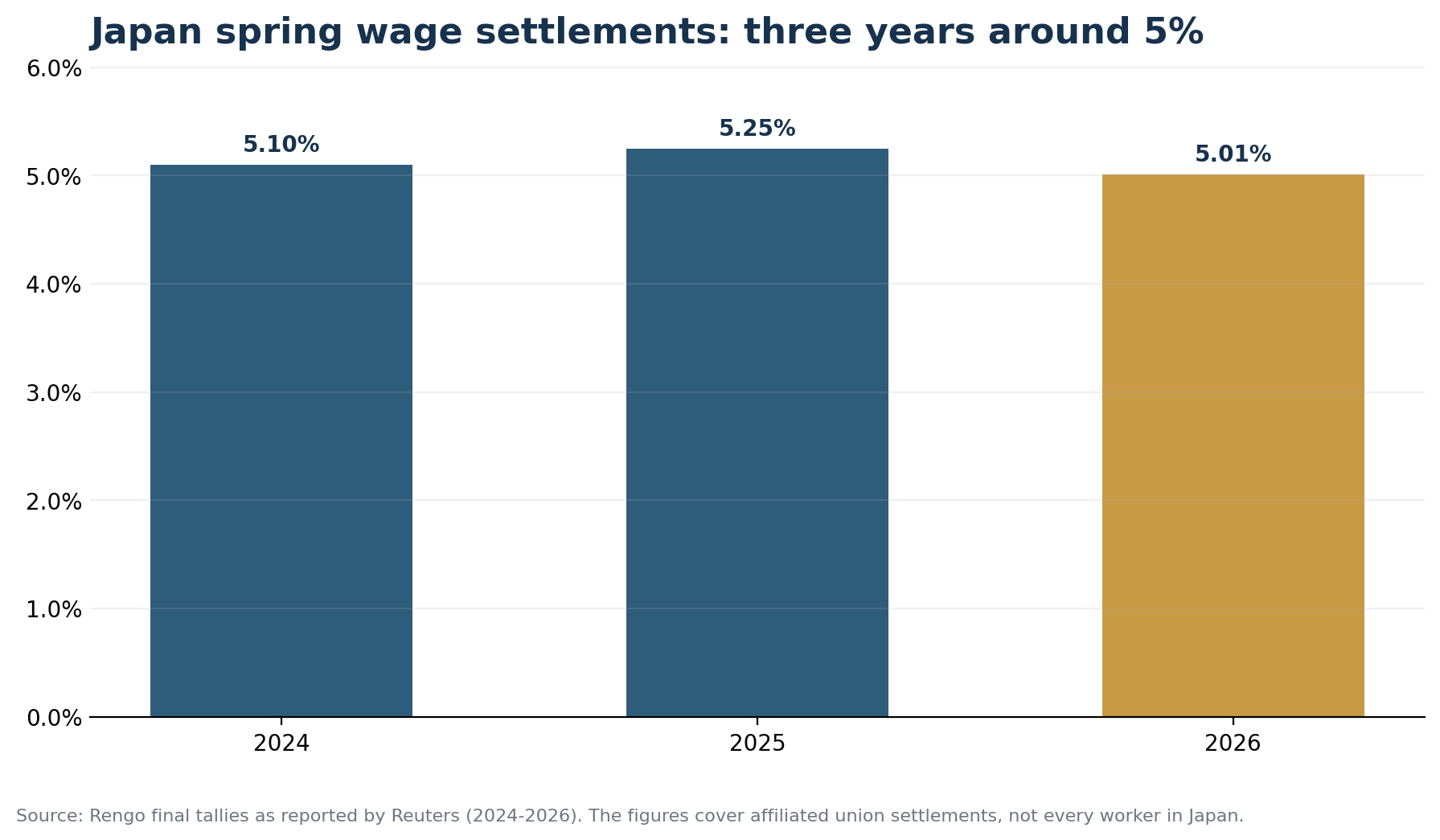
Japan's macro story is changing, but the change should be described carefully. The clearest signal is wages. Rengo's final tally for the 2026 spring wage negotiations showed an average increase of 5.01% among affiliated companies, after 5.25% in 2025 and 5.10% in 2024. Three consecutive years around 5% do not erase decades of wage stagnation, but they are difficult to treat as noise.[6]
The OECD's June 2026 outlook is a useful reality check. It projects real GDP growth of 0.6% in 2026 and 0.8% in 2027. That is moderate growth, not a conventional boom. At the same time, the OECD expects domestic demand to remain the main driver, with wage growth supporting consumption and high corporate profits and policy support helping investment.[7]
The more interesting question, therefore, is not whether Japan will suddenly produce emerging-market growth rates. It is whether a mature economy can move from a long period of low nominal growth and underinvestment into a durable cycle of wages, pricing power, capital expenditure and productivity investment. That is a different kind of reawakening.
04 · INVESTMENT CYCLEA policy shift from caution toward investment
Japan's 2026 Growth Strategy draft explicitly tries to break with chronic underinvestment. Across 17 strategic fields and 62 major products and technologies, the policy framework maps more than ¥370 trillion in cumulative public-private domestic investment through FY2040. The number is a roadmap and ambition, not cash already committed or guaranteed to be realised.[8]
The scale becomes more concrete in AI and semiconductors. METI's industrial strategy calls for at least ¥10 trillion in public support for AI and semiconductors by FY2030, with the aim of encouraging more than ¥50 trillion in public-private investment over ten years. These figures have different scopes and should not be added mechanically, but they show the direction of policy: rebuilding production capacity, digital infrastructure and strategic technology supply chains.[9]
This matters beyond semiconductor factories. Large capital programs create second-order demand for engineering, software, construction, data centres, energy systems, logistics, business services, housing and urban infrastructure. Economic opportunity is often found not only in the headline industry but in the networks built around it.
05 · INTERNATIONAL DEMANDThe world is coming to Japan — and spending more
Japan welcomed 42.68 million international visitors in 2025, up from 36.87 million in 2024 and a new annual record.[10] The Japan Tourism Agency's final 2025 estimate puts inbound travel spending at ¥9.4549 trillion, up 16.4% from 2024. Tourism is not the same as permanent residential demand, but it is now a large service-export channel affecting hotels, retail, restaurants, transport, entertainment and selected property markets.[11]
Japan is also actively seeking more foreign capital. The government has set a target of reaching a ¥120 trillion inward FDI stock balance by 2030. A target is not an outcome, but it signals a policy preference for bringing more capital, talent and business activity into the economy.[12]
06 · TOKYO RESIDENTIALWhat does this mean for Tokyo real estate?
Japan's national population decline does not produce one uniform housing market. CBRE notes that 30% of the population is already concentrated in the 21 major cities and expects urbanisation to intensify as people continue to move toward areas with jobs. It therefore expects stable rental demand to persist in urban areas even as the national population ages and declines.[14]
That does not mean every Tokyo property is attractive. The useful unit of analysis is smaller: the station catchment, building quality, layout, management, seismic standards, tenant profile, financing conditions and the depth of future demand.
For buyers
Relative global value can be real while purchase prices and rents are rising. Focus on properties where daily utility is difficult to replicate: strong station access, coherent neighborhood services, durable building management and layouts suited to identifiable demand. A discount alone is not a thesis.
For sellers
A broader international buyer pool increases the value of presentation and documentation. Clear bilingual materials, defensible pricing, building-management records and a well-organised transaction process can reduce friction. International demand does not eliminate price sensitivity; it rewards transparency.
For investors
The national demographic story is too blunt for asset selection. Urban concentration, household structure and foreign inflows can support rental demand in major cities, but outcomes diverge sharply by submarket and product type. Underwrite the micro-market first and use the macro story as context, not a substitute for due diligence.
07 · REALITY CHECKA reawakening is not a guaranteed boom
The opportunity case has real constraints. OECD projections remain moderate. Japan is exposed to imported-energy shocks. Public debt is large. Higher construction costs, higher interest rates and rising urban rents can weaken affordability. Tourism growth creates congestion and political pressure in selected destinations. Currency comparisons can also change quickly.[7]
Industrial policy carries execution risk as well. Public support does not guarantee globally competitive companies, and strategic projects can be delayed by technology, energy, talent or cost constraints. The correct conclusion is not that Japan has solved its structural problems. The opportunity may exist precisely because a highly developed economy is being forced to reform, invest and open in response to those pressures.
08 · GAISAPP PERSPECTIVESelectivity over slogans
The most important question is not whether “Japan will rise” in the abstract. It is which locations, building types and demand corridors are positioned to benefit from Japan's changing economic geography.
For Tokyo residential property, we look for the overlap of four forces: global-city utility, constrained quality supply, urban concentration and durable international or domestic demand. That is a more useful framework than buying simply because the yen looks weak or because a national headline is positive.
Japan's quiet reawakening is best understood as a change in direction rather than a promise of speed. For residents, that direction means a world-class daily environment that still offers unusual relative value in selected segments. For investors and business builders, it means a mature economy with more capital, more wage pressure, more international demand and a stronger reason to invest in productivity.
The opportunity is real. So is the need to choose carefully.
Positioning for Japan's next cycle requires local diligence, not a macro slogan.
GAISAPP helps international clients evaluate Tokyo residential opportunities through bilingual sourcing, neighborhood analysis, transaction coordination and long-term ownership planning.
Book a Private ConsultationResearch downloads
Download the article research brief · Download the chart data workbook
Sources and reference links
- Monocle — How Tokyo made it to the top of the 2026 Quality of Life Survey
- Mori Memorial Foundation — Global Power City Index 2025
- Japan Real Estate Institute — Global Property Value/Rent Indices No. 25, Oct. 2025
- Tokyo Metro — Regular ticket fares
- Ministry of Health, Labour and Welfare — Health insurance qualification and co-payment guide
- Reuters — Japan 2026 wage talks final tally
- OECD — Economic Outlook 2026, Japan
- Cabinet Secretariat — Japan Growth Strategy draft, June 2026
- METI — Industrial Structure in 2040 Led by Growth Investment
- JNTO — 2025 annual visitor statistics
- Japan Tourism Agency — 2025 final inbound travel spending
- Ministry of Foreign Affairs — Foreign Direct Investment in Japan
- Savills — Tokyo Residential Leasing Q1/2026
- CBRE — Japan Rental Housing: Fundamentals remain strong despite aging population
Disclaimer
This article is general information prepared for GAISAPP; it is not financial, legal or tax advice. Market data are stated as of the dates of the cited sources and may be revised. Rankings use different methodologies. JREI comparisons shown here are high-end appraisal benchmarks and should not be read as average household rents. Government investment and FDI figures include policy targets, roadmaps or scenarios and are not guaranteed outcomes. Property prices, availability and transaction conditions must be independently confirmed. Real-estate execution, legal, tax, financing and registration matters should be handled by qualified professionals where required.